UPES M.Sc Admissions 2027
Ranked #45 Among Universities in India by NIRF | 1950+ Students Placed 91% Placement, 800+ Recruiters


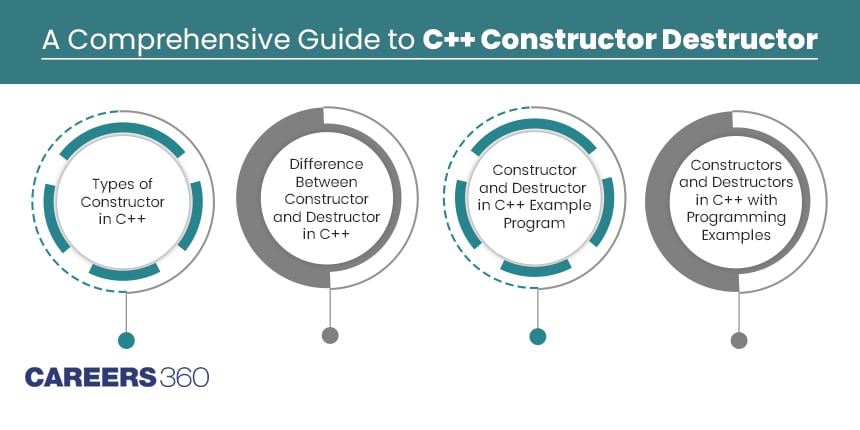
In C++, mastering the nuances of constructors and destructors is essential for crafting robust and efficient applications. Constructors initiate the foundation of object-oriented programming, while destructors elegantly conclude an object's lifecycle. This article explores types of constructor in C++, highlights the subtle difference between constructor and destructor in C++, and provides practical examples for a better understanding.
This Story also Contains
If you are interested in gaining further knowledge in this field, you can have a look at C Certification Courses listed on our website.
Also Read:
C++ revolves around the principles of object-oriented programming, where classes and objects form the building blocks of applications. Constructors and destructors in C++ are critical components that manage the creation and destruction of objects.
In C++, constructors come in various types, each serving a specific purpose:
Default Constructor: Initialises the object with default values.
Parameterized Constructor: Takes parameters to initialise object properties.
Copy Constructor: Creates a new object as a copy of an existing object.
Static Constructor: Initialises static data members of a class.
Also Read:
In the constructor and destructor program in C++, constructors are involved in initialising objects, while destructors play a crucial role in freeing up resources and performing cleanup when an object goes out of scope. Their syntax varies in terms of calling each feature.
The constructor does not have a return type and is created similar to a class, whereas the destructor is the same as the class name preceded by a tilde(~).The key difference lies in their purposes: constructors set up the object, and destructors tear it down.
Let us illustrate the concepts with a basic example program:
#include <iostream>
using namespace std;
class MyClass {
public:
// Constructor
MyClass() {
cout << "Constructor called!" << endl;
}
// Destructor
~MyClass() {
cout << "Destructor called!" << endl;
}
};
int main() {
// Creating an object
MyClass obj;
// Object goes out of scope, triggering the destructor
return 0;
}
In this example, the constructor is called when an object of MyClass is created, and the destructor is called when the object goes out of scope.
Now, let us explore more advanced scenarios:
#include <iostream>
using namespace std;
//Creating a class that captures the attributes of a rectangle
class Rectangle {
private:
int length;
int width;
public:
// Parameterized Constructor
Rectangle(int len, int wid) : length(len), width(wid) {
cout << "Rectangle created with length " << length << " and width " << width << endl;
}
// Destructor
~Rectangle() {
cout << "Rectangle destroyed." << endl;
}
};
int main() {
// Creating objects with parameterized constructors
Rectangle smallRect(5, 3);
Rectangle largeRect(10, 7);
// Objects go out of scope, triggering destructors
return 0;
}
In this example, we use a parameterized constructor to create objects with specific dimensions. The destructors are automatically called when the objects go out of scope.
Related: C Certification Courses by Top Providers
In the intricate world of C++ programming, constructors and destructors play a pivotal role in managing objects' lifecycles. Armed with knowledge about the types, differences, and practical examples, developers can navigate the complexities of object-oriented programming with confidence. Constructors set the stage, and destructors gracefully close it, ensuring that C++ applications run efficiently and reliably.
Frequently Asked Questions (FAQs)
Knowledge of constructor and destructor types allows developers to tailor their approach to object initialisation and cleanup based on specific programming requirements, ensuring efficient and effective code.
In the provided example, a parameterized constructor is used to create objects with specific dimensions, showcasing practical implementation.
The primary distinction lies in their functions – constructors initialise objects, while destructors manage the cleanup and resource deallocation when an object goes out of scope.
C++ features several constructor types, including default, parameterized, copy, and static constructors. Each serves a specific purpose in object initialisation.
In C++, a constructor initialises an object when it is created. It plays a crucial role in setting up the object's initial state.


Get Job Ready in Healthcare | Employability-Focused Programs
Ranked #45 Among Universities in India by NIRF | Get Upto 100% Scholarships | Spot Admissions via CUET
100+ Recruiters | 100+ Placements of 2026 Batch | NBA & NAAC Accredited | Highest CTC 37 LPA
100+ Recruiters | 1200+ Placements of 2026 Batch | NBA & NAAC A Accredited | Highest CTC 37 LPA
100+ Recruiters | 100+ Placements of 2026 Batch | NBA & NAAC Accredited | Highest CTC 37 LPA
NAAC A Grade | 27+ Years of Excellence in Education | Affiliated to RGUHS | INC Approved | Scholarships upto 100%